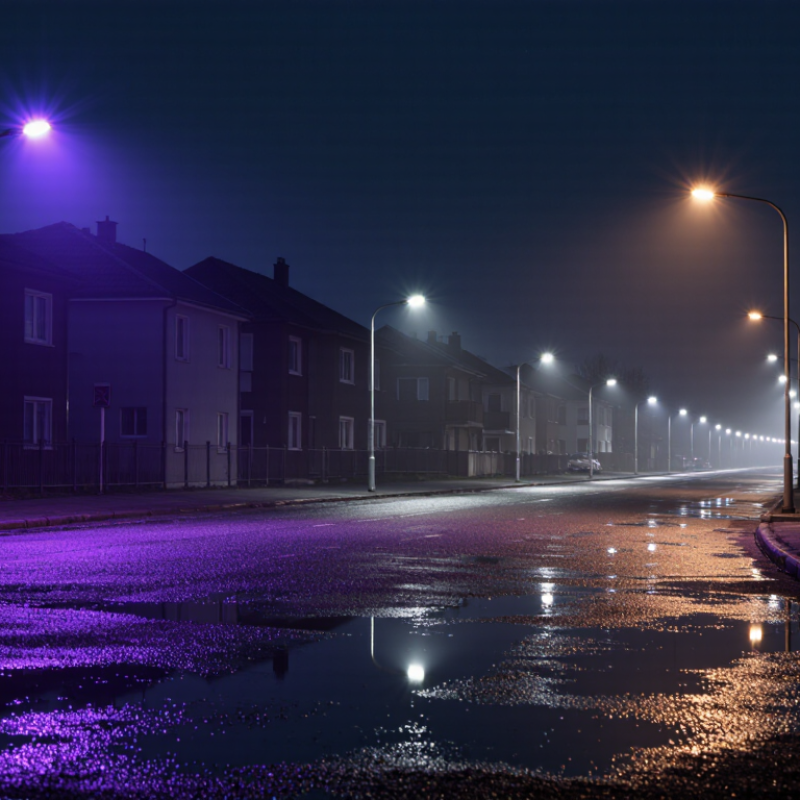
A street that should glow warm white can suddenly look violet. One lamp may change first, leaving a purple patch on wet pavement while nearby fixtures remain normal. This color shift can be more than a visual annoyance. It may signal changes inside the LED package, lens, or fixture.
So, what causes LED street lights to turn purple? Many white LEDs use blue light combined with a yellow phosphor coating. If that coating weakens, separates, or deteriorates, more blue light can escape, making the lamp appear blue or purple. Heat, age, moisture, manufacturing defects, and physical damage may contribute. The exact cause depends on the fixture and its operating conditions. A purple color alone cannot confirm a failed component.
Look closely, but do not assume. Is the hue uniform across the lens, or concentrated in one area? Did several lights change at once? Those details can help maintenance teams narrow down the issue. A flicker, dark spots, or a cracked cover may offer additional clues. Still, appearances can mislead.
This guide explores ten common reasons LED street lights turn purple, from phosphor deterioration to environmental stress and fixture problems. It also explains which observations are useful and when a qualified technician should inspect the light. Some causes overlap. That can make diagnosis less tidy than expected.
White street lighting usually begins with a blue LED chip. A phosphor coating absorbs part of its blue output and re-emits broader wavelengths. The combined light appears white to our eyes. The phosphor’s composition and thickness influence its color temperature and tint. Small differences matter.
Color is measured, not judged only by appearance. The ANSI/IES C78.377 standard defines chromaticity ranges for solid-state lighting, helping manufacturers specify consistent white light. The U.S. Department of Energy’s 2022 Solid-State Lighting R&D Opportunities report describes laboratory LED packages exceeding 200 lumens per watt. That figure measures light output per unit of power, not color quality or street-fixture performance. Easy to confuse.
In a street luminaire, optics, phosphor, temperature, and aging all affect the final color. A blue chip and phosphor must work together as a system. If the phosphor layer degrades or separates, more blue light may escape, making a lamp look violet. DOE research on LED color maintenance identifies material and operating conditions as factors in color shift. I would not diagnose a purple lamp from a photo alone; nearby lighting and camera settings can distort the appearance. Check several fixtures in person.
A common white street LED uses a blue chip beneath a phosphor layer that converts some blue light into warmer colors. If that layer cracks, separates, or degrades, more blue light escapes. Mixed with the remaining phosphor output, it can appear violet or purple from the sidewalk. The shift may be subtle at first. Then it stands out. Heat is a frequent stressor inside sealed fixtures, especially when cooling surfaces collect dust or airflow is limited. Moisture and repeated hot-cold cycles can also worsen package damage.
The chip itself can fail, but chip failure does not always create a purple tint. It may instead cause dimming, flicker, or uneven color, so the phosphor deserves close inspection. Color alone is not a diagnosis. A camera’s white balance, nearby lighting, and viewing angle can distort what looks purple to the eye. Maintenance crews can compare the fixture with nearby lights and inspect the LED package for cracks, discoloration, or uneven output. A handheld spectrum meter can help confirm whether blue emission has increased. I have to admit, a quick visual check can miss early damage. Record the fixture’s appearance at night, then arrange a qualified inspection if the tint persists or spreads.
Top 10 Reasons LED Street Lights Turn Purple
A purple streetlight often points to a change inside the LED package, not simply “old age.” Many white LEDs use a blue chip and a phosphor layer to create balanced white light. Heat can discolor or damage that layer, letting more blue-violet light escape. Poor heat transfer, blocked ventilation, or a hot driver enclosure can make the problem worse. The DOE report LED Luminaire Reliability: Recommendations for Testing and Reporting identifies temperature as an important factor in LED degradation. Yet heat alone does not explain every purple lamp.
Electrical stress can add to the damage. Unstable drive current, repeated surges, or a failing driver may raise chip temperature and speed material changes. The color shift can appear as a violet patch, a blue edge, or a whole roadway with an unexpectedly cold cast. Not every stressed LED turns purple; that part is easy to oversimplify. IES LM-80 testing measures light output and chromaticity over at least 6,000 hours, helping compare how LED packages change under controlled temperatures.
A useful field check is to compare neighboring fixtures after dark. If one lamp has a sharp purple tint while nearby lights remain white, document its location and report the pattern for inspection. A technician can check the driver, thermal path, and LED module before replacing parts. Even careful measurements have limits: a test bench cannot fully reproduce years of vibration, weather, and real street-level heat.
| # | Possible Cause | How It Can Change the Light Color | Common Clues | Likelihood | Recommended Check |
|---|---|---|---|---|---|
| 1 | Phosphor layer deterioration or separation | Many white LEDs use a blue LED chip with a phosphor coating to convert some blue light into longer wavelengths. If the phosphor layer degrades or separates, more of the chip’s blue-violet light can escape, making the lamp appear purple or violet. | One or more LED modules look purple while nearby lights remain white; discoloration may spread over time. | High | Inspect the LED board and optical materials. Replace the affected LED module or luminaire if the conversion layer has failed. |
| 2 | Excessive operating temperature | High LED junction temperatures accelerate degradation of phosphors, encapsulants, and other optical materials. Heat may therefore contribute to a gradual color shift, although it does not always produce a purple appearance by itself. | Color change is more pronounced after long operating periods; the housing or heat sink may be unusually hot. | High as a contributor | Check for blocked heat-sink surfaces, poor ventilation, loose thermal interfaces, or an unsuitable operating environment. |
| 3 | Age-related optical-material degradation | With extended use, phosphors, silicone encapsulants, lenses, and other optical components can change in transmission or conversion efficiency. This can alter the balance of wavelengths leaving the fixture. | Older fixtures show uneven color or reduced light output; affected units may be concentrated in one installation area. | High | Compare the fixture’s age and operating hours with unaffected units. Measure color and output, then assess whether replacement is appropriate. |
| 4 | Excessive drive current or incorrect driver settings | Current above the LED module’s rated operating range can increase heat and accelerate material degradation. It may also alter LED output characteristics; sustained overdrive is more likely to cause lasting color change than a brief electrical fluctuation. | Elevated temperature, premature failure, or similar color changes across fixtures using the same driver setup. | Medium to high | Have a qualified technician verify driver output current and confirm it matches the LED module’s electrical ratings. |
| 5 | Driver failure or excessive output ripple | A failing driver can provide unstable current or voltage. This commonly causes flicker, dimming, or intermittent operation; prolonged abnormal output may add electrical and thermal stress that contributes to color shift. | Flickering, pulsing brightness, intermittent shutdown, or a color change occurring alongside other electrical symptoms. | Medium | Check the driver’s output and ripple with suitable test equipment, and replace it if it is outside its specified operating limits. |
| 6 | Moisture ingress or corrosion | Water or condensation inside a fixture can corrode electrical connections and damage optical or electronic components. Resulting faults may cause uneven output, flicker, or abnormal color. | Condensation, water marks, corrosion, damaged seals, or color changes that vary with weather. | Medium | Inspect gaskets, seals, cable entries, and the enclosure. Correct the ingress path and replace damaged components. |
| 7 | UV exposure or chemical contamination | Ultraviolet exposure and certain chemicals can degrade or discolor polymers and optical coatings. Changes to a lens or encapsulant can affect transmitted light and may make the output look different. | Yellowed, hazy, cracked, or discolored optical parts; damage may be worse on sun-exposed or contaminated surfaces. | Medium | Inspect the lens and encapsulant for physical changes. Use replacement optical parts specified for the fixture and its environment. |
| 8 | Manufacturing variation or an early component defect | A defective or inconsistent phosphor coating, LED package, or optical assembly can produce an abnormal color from the start or cause early color instability. | A new fixture or a small group from the same installation shows a noticeably different color soon after commissioning. | Low to medium | Record the affected unit details and compare its color with other units under the same conditions. Request inspection or replacement under the applicable warranty. |
| 9 | Replacement LED modules with a different color specification | A replacement module with a different phosphor design, color temperature, or spectral distribution may look noticeably different from the original, even when both are described as white light. | Color mismatch begins after repair, and the replacement module looks different from adjacent modules. | Low to medium | Confirm that replacement parts match the fixture’s approved module and color specification. |
| 10 | Optical damage, dirt, or surface deposits | Damage or deposits on the lens can change how light is transmitted or scattered. This more often changes brightness or appearance than causes a true internal purple color shift, but it can make the fixture look unusual. | Visible dirt, scratches, cracks, clouding, or a color effect that changes when viewed from a different angle. | Low | Clean the exterior using the fixture manufacturer’s approved method and inspect the lens for permanent damage. |
Note: A purple appearance is often associated with loss or deterioration of the phosphor conversion layer, but color alone cannot identify the exact fault. Electrical testing and inspection should be performed by a qualified person with the power safely isolated.
Top 10 Reasons LED Street Lights Turn Purple
How Materials, Manufacturing, and Weather Affect LED Color
Purple streetlights often point to a failure inside blue-pumped LED packages. A phosphor layer normally converts some blue light into other colors. If that layer cracks, separates, or degrades, more blue light escapes, making the lamp look violet. DOE reliability research identifies heat, optical materials, and package construction as important influences on color stability. The exact cause still needs inspection; a purple glow alone is not a diagnosis.
Manufacturing details matter. Uneven phosphor thickness, weak bonding, or contamination can leave some LED chips more vulnerable than others. Heat builds near tightly packed LEDs, especially inside poorly ventilated housings. It can accelerate changes in phosphors and encapsulants. Weather adds stress: moisture can enter damaged seals, while repeated hot-cold cycles strain joints and coatings. The street may look evenly lit. The damage may be local.
There is useful test data, but also a limitation. IES LM-80-20 evaluates LED package or module light output and chromaticity over at least 6,000 operating hours, with readings taken at intervals no longer than 1,000 hours. Testing commonly includes 55°C and 85°C, plus a manufacturer-selected temperature. These are controlled conditions, not a full street-weather simulation. A strong field check compares affected fixtures with nearby units, records operating temperature, and examines seals and LED boards. Sometimes the evidence remains inconclusive.
How materials, manufacturing, and weather can affect perceived LED color
Phosphor-layer defects or aging can reduce the conversion of blue LED light, making a fixture look unusually blue or violet. Heat, moisture, UV exposure, and material variation can contribute; wet surfaces and camera settings can also change how the color appears. Scores show qualitative troubleshooting priority, not measured failure rates.
Purple light usually signals a failed color-conversion layer, not a normal change in brightness. Many white LEDs use a blue chip and phosphor coating; if that coating cracks, separates, or degrades, more blue-violet light escapes. The U.S. Department of Energy’s 2011 technical report, “LED Luminaire Reliability: Impact of Color Shift,” describes phosphor and encapsulant aging as causes of color change. Confirm the issue at night with the naked eye: phone cameras can alter white balance and make white lamps look purple.
A field check should compare the affected fixture with nearby lights of the same type. Photograph the lamp, note its location, operating hours, and any recent heat or water exposure. Ask a qualified maintenance technician to inspect the LED board, seals, and driver; a driver fault can cause flicker, but is less likely to explain a stable purple tint. IES LM-80 testing tracks LED-package color and lumen maintenance for at least 6,000 hours, while TM-21 uses test data to project longer-term performance. These tests help assess components, but do not guarantee an entire fixture’s service life. Replace a visibly discolored module or fixture, then check whether others from the same batch show the same change.
Tips: Keep a simple photo log. Record the fixture ID and date, and compare color at similar viewing angles. Don’t judge from a phone image alone.
Many white LEDs use a blue chip and a phosphor coating. If the coating cracks, separates, or degrades, more blue-violet light escapes. The exact cause can vary.
Not necessarily. Heat, electrical stress, or material changes can affect the color-conversion layer. Age alone does not explain every purple lamp.
Yes. Poor heat transfer, blocked ventilation, or a hot driver enclosure can raise temperatures. A damaged phosphor layer may then let more blue-violet light through.
Electrical stress from unstable current or repeated surges may speed material changes. A driver fault can cause flicker, but it is less likely to explain a steady purple tint. Not always.
Compare it with nearby lights of the same type after dark. Look from a similar angle. Phone cameras can alter white balance and misrepresent the color.
Note the fixture location, visible ID, date, and operating pattern. Take a photo, but do not rely on it alone. Keep notes.
A qualified technician can check the LED board, seals, thermal path, and driver. They may also look for heat or water exposure.
Component tests can track color and light output under controlled conditions. They cannot fully reproduce years of vibration, weather, and street-level heat. That limitation matters.
Not automatically. Replace a visibly discolored module or fixture, then check other lights from the same batch. One lamp is a clue, not proof.
This article explains how LED street lights create their intended white color by combining light from an LED chip with a phosphor coating. It explores what causes LED street lights to turn purple, including damage or deterioration in the phosphor layer, changes in the LED chip, and shifts in the balance of emitted light. Heat, electrical stress, and normal aging can gradually affect these components, while material quality, manufacturing variations, moisture, and harsh weather may contribute to color changes.
The article also outlines practical ways to diagnose purple street lights, such as checking whether the color is widespread or limited to individual fixtures and looking for signs of physical or environmental damage. Understanding the likely cause can help determine whether inspection, repair, or replacement is appropriate. By recognizing how component failures and operating conditions affect color, readers can better assess purple lighting and support more consistent, reliable street illumination.

Dorde Lights