Choosing outdoor lighting can feel simple until a driveway, warehouse wall, or sports court remains poorly illuminated. The practical question is not only what looks brighter. It is what beam pattern, mounting height, wattage, and environment can deliver useful light. That is why many buyers ask, “what is the difference between floodlight and spotlight?” The answer begins with beam spread. A floodlight produces a wide, broad beam. It can cover loading areas, façades, gardens, and parking spaces. A spotlight creates a narrow, concentrated beam. It suits signs, trees, architectural details, and distant targets.
Lighting designer James R. Benya puts the principle plainly: “Lighting must support the visual task.” This idea matters when comparing China top floodlights vs spotlights. A high-output floodlight may waste energy if its beam spills beyond the target. A spotlight may look powerful but leave dark areas around it. In real installations, I have seen a narrow beam miss a doorway by only a few metres. The product was not defective. The selection was wrong.
Quality also depends on more than lumens. Check beam angle, LED efficiency, color temperature, IP rating, heat management, driver stability, and tested lifespan. Ask for photometric files, not only attractive product photos. A supplier’s factory experience, inspection records, and warranty terms deserve attention. Still, specifications can mislead when installation conditions change. Dust, rain, mounting height, and nearby buildings all affect performance. The best choice is rarely the brightest fixture. It is the fixture that places light where people actually need it.
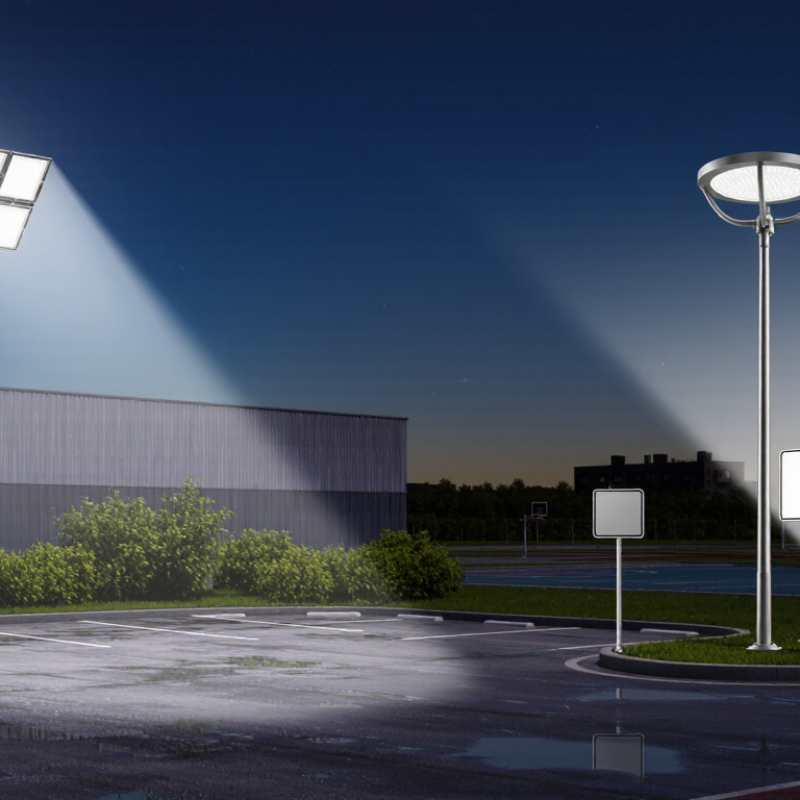
Floodlights and spotlights are both directional luminaires, but their optical jobs differ. A floodlight spreads light across a broad beam, commonly around 90 to 120 degrees. It suits building façades, yards, sports areas, and loading zones. A spotlight uses a narrow beam, often below 30 degrees, to emphasize signs, trees, artwork, or distant targets. The visual result is simple: floodlights create coverage, while spotlights create focus.
Their functions also shape installation decisions. Floodlights usually need higher total lumens because they cover larger surfaces. Spotlights may use fewer lumens, but they demand accurate aiming. A five-degree aiming error can move a bright patch several metres away. Beam angle, mounting height, glare control, colour temperature, and ingress protection should be checked together. A powerful lamp does not automatically produce useful illumination. Sometimes, it creates harsh shadows and wasted light.
The International Energy Agency reported in Energy Efficiency 2023 that lighting represents roughly 15% of global electricity consumption. The U.S. Department of Energy’s Solid-State Lighting research reports show that LED efficacy has passed 200 lumens per watt in laboratory demonstrations, while installed products normally perform lower. These figures matter because optical design affects real efficiency. A floodlight with poor shielding may illuminate the sky instead of the pavement. A spotlight may look dramatic but leave surrounding steps dark. The boundary is not absolute; adjustable floodlights can narrow their beam, and wide spotlights can overlap in practice. Testing the beam on site remains wiser than trusting a catalogue drawing.
Floodlights and spotlights differ mainly in beam control. Floodlights usually spread light above 40°, covering walls, yards, signs, and building facades. Spotlights commonly stay below 15°, creating a narrow, intense beam for trees, displays, or architectural details. The wider beam reduces dark gaps. The narrow beam reaches farther.
Beam angle alone can mislead. A 10° spotlight may produce a bright center but poor visual comfort when aimed at eye level. A 45° floodlight may cover a large area, yet waste light beyond the target. The Illuminating Engineering Society’s LM-79 method requires measured photometric performance, including luminous flux and distribution. Ask for that test data, not only marketing diagrams. The U.S. Department of Energy’s solid-state lighting reports also show that optical control remains essential for improving useful light, not just fixture efficiency.
Tips: Match beam angle with mounting height and target distance. For a 6-metre wall, test a 15° beam before choosing a 45° model. Check the IES file, candela chart, glare rating, and delivered lumens. IEA reports that lighting still represents about 10% of global electricity demand, so poor aiming has a measurable cost. These thresholds are practical, not universal standards. In real projects, a 20° beam can sometimes perform better than either category. That is the part many buyers overlook.
| Comparison Dimension | Floodlights | Spotlights | Practical Note |
|---|---|---|---|
| Typical Beam Angle | Usually above 40°, producing a broad spread of light across a relatively large area. | Usually below 15°, producing a narrow and concentrated beam. | Exact beam classifications may vary by lighting manufacturer and application. |
| Primary Lighting Purpose | Area illumination, general outdoor lighting, and uniform coverage. | Accent lighting, highlighting, long-distance illumination, and visual emphasis. | Select the fixture according to the target area and desired lighting effect. |
| Light Distribution | Wide distribution with light spread across a broad horizontal and vertical area. | Focused distribution with most light directed toward a smaller target area. | Beam angle strongly affects coverage width and light intensity. |
| Coverage Area | Suitable for yards, façades, construction areas, parking areas, sports grounds, and warehouses. | Suitable for signs, architectural details, landscape features, stages, towers, and distant objects. | A wider beam covers more area but generally provides less intensity at the center. |
| Light Intensity at the Target | More evenly distributed, with lower peak intensity over each point when the same lumen output is used. | Higher peak intensity on the selected target because the light is concentrated into a narrower beam. | Illuminance is measured in lux and depends on distance, beam angle, and luminous flux. |
| Lighting Distance | Best for short-to-medium distances where broad coverage is required. | Effective for medium-to-long distances where a defined target must be reached. | The inverse-square law means illuminance decreases as the distance from the fixture increases. |
| Shadow Characteristics | Can reduce harsh shadows when several fixtures or broad sources are used from different directions. | Can create stronger shadows and sharper contrast, especially when aimed from one direction. | Multiple fixture positions can improve visual balance and reduce unwanted dark areas. |
| Mounting and Aiming | Often mounted on walls, poles, ceilings, brackets, or high masts and aimed toward an area. | Usually mounted on adjustable tracks, brackets, poles, or bases for precise aiming. | Mounting height and tilt angle influence the actual illuminated footprint. |
| Recommended Outdoor Use | Security lighting, building exteriors, loading areas, road-side areas, sports facilities, and large open spaces. | Landscape accents, architectural highlighting, flagpoles, monuments, billboards, and selected outdoor features. | Outdoor fixtures should be selected with suitable ingress protection for the environment. |
| Glare Management | May create wide-area glare if installed too low or aimed toward observers. | May create intense glare when viewed directly because of its concentrated beam. | Use shielding, correct aiming, and suitable mounting height to control glare. |
| Best Choice When... | The goal is to illuminate a broad area with relatively consistent brightness. | The goal is to emphasize a specific object or project light over a longer distance. | Beam angle should be chosen before finalizing wattage and mounting position. |
Floodlights and spotlights serve different optical purposes. A floodlight spreads light across a wide area, such as a yard, warehouse, or sports court. A spotlight concentrates lumens into a narrow beam for façades, signs, trees, or distant targets. The same wattage can look completely different because beam angle changes perceived brightness.
LED performance needs more than wattage. Industry testing data commonly places efficient outdoor luminaires around 100–180 lm/W, although driver losses, optics, heat, and dirt reduce real output. The U.S. Department of Energy’s Solid-State Lighting reports identify thermal management and optical control as major performance factors. Lumen output matters at the target surface, not only on the product label. For general outdoor visibility, 4000–5000K often provides a crisp appearance. Warmer 2700–3000K can reduce glare and feel less harsh. CRI 80 is adequate for many security areas, while CRI 90 improves color recognition. Higher CRI may reduce efficacy slightly. That trade-off deserves honest testing.
Tips: Check delivered lumens, beam angle, and photometric files together. Ask for testing under LM-79 conditions, not only laboratory chips. Select CCT by site use, not personal preference. A 150 lm/W floodlight may still disappoint if its beam wastes light. I have seen this mistake repeatedly. Efficiency is not the whole story.
China Top Floodlights vs Spotlights: What Is the Difference?
Floodlights spread light across wide areas, while spotlights create a narrower, more concentrated beam. Both can serve outdoor projects, but protection standards often decide long-term performance. IP65 means a fixture is dust-tight and protected against water jets. IP66 offers stronger protection against powerful water jets. These ratings follow IEC 60529 testing methods, not marketing language.
For China-made fixtures, IP65–IP66 matters around parking areas, gardens, warehouses, and building walls. Rain can enter through weak seals, loose cable glands, or poorly fitted covers. A fixture may pass a factory test yet fail after repeated temperature changes. That is an uncomfortable detail. Check the test report, sealing materials, drainage design, and cable entry points. IP ratings do not confirm resistance to impact, salt spray, ultraviolet exposure, or overheating. Those risks need separate evidence.
Tips: Ask for an independent test report and inspect a production sample. Confirm whether the rating applies to the complete fixture, not only the housing. Install cable glands facing downward when possible. Leave space around the housing for heat release. In coastal locations, examine corrosion protection carefully. A bright light is not automatically a reliable light. The installation details matter.
Floodlights and spotlights serve different lighting jobs, even when their housings look similar. A floodlight spreads a broad beam across yards, work areas, building fronts, or sports fields. Its wide coverage reduces dark patches at short and medium distances. A spotlight sends a narrow, concentrated beam toward a sign, tree, tower, or distant entrance. It reaches farther, but the illuminated area stays smaller. Beam angle matters more than appearance. A 120-degree beam may cover a driveway, while a 15-degree beam can emphasize one architectural feature. Measure mounting height and target distance before choosing.
Wattage should not be the only decision. Not always. Lumens show total light output, while beam angle and optics decide where that light goes. For a 6-meter wall, a moderate-wattage floodlight may work better than a powerful spotlight. For a 40-meter gate, a focused beam can provide useful brightness without wasting light sideways. In outdoor installations, check the IP rating, heat dissipation, cable protection, and glare control. I have seen bright fixtures create harsh shadows and poor visibility. More light was not better. Color temperature also changes the result; neutral white often preserves surface detail, while very cool white can feel severe. Test one fixture at night if possible. Real sites rarely match drawings perfectly. Reflective walls, rain, and nearby trees can change the outcome, so leave room to adjust the angle and output.
Choosing the Right Light: Area Coverage, Distance, Wattage, and Applications
Wide beam angles of approximately 60°–120° provide broad area coverage. Typical LED power ranges from 20 W to 300 W, making floodlights suitable for yards, building facades, parking areas, sports spaces, and construction sites.
Narrow beam angles of approximately 5°–15° concentrate light over longer distances. Typical LED power ranges from 5 W to 100 W, making spotlights suitable for signs, trees, architectural details, stages, and security targets.
The chart uses representative beam angles of 120° for a floodlight and 15° for a spotlight. Beam diameter is calculated as 2 × distance × tan(beam angle ÷ 2), assuming unobstructed light distribution.
A floodlight spreads light across a broad area, often with a 90–120-degree beam. A spotlight concentrates light within a narrower beam, commonly below 30 degrees. One creates coverage. The other creates focus.
Floodlights suit yards, building façades, sports courts, loading zones, and warehouse surroundings. They cover wide pavement with fewer aiming adjustments. Poor shielding may send light toward windows or the sky.
Spotlights suit signs, trees, artwork, façades, and distant targets. They create a bright visual point. Nearby steps may remain dark.
Usually, yes, because they illuminate larger surfaces. However, beam angle changes perceived brightness. A lower-lumen spotlight can look intense on one small target.
Narrow beams react strongly to small aiming errors. A five-degree error can move the bright patch several metres. Check the beam after installation. Catalogue drawings can mislead.
Check delivered lumens, beam angle, colour temperature, CRI, mounting height, and ingress protection. Also review thermal management and optical control. Wattage alone is not enough.
Around 4000–5000K often provides a crisp appearance for general outdoor visibility. Around 2700–3000K can feel softer and reduce harsh glare. CRI 80 suits many security areas, while CRI 90 improves colour recognition. Higher CRI may slightly reduce efficacy.
Efficient outdoor products commonly reach about 100–180 lumens per watt. Installed output is lower because drivers, optics, heat, and dirt reduce performance. A high efficiency rating can still disappoint. I have seen this mistake repeatedly.
Compare photometric files, delivered lumens, and beam angles together. Request testing under recognised LM-79 conditions when available. Test the beam on site at night. That practical check matters most.
Not always. Adjustable floodlights can narrow their beams, while wide spotlights may overlap in practice. The boundary is not absolute. Test it outdoors.
Floodlights and spotlights are both designed to improve visibility, but their beam patterns serve different purposes. The key question is: what is the difference between floodlight and spotlight? Floodlights typically produce wide beams above 40°, making them suitable for illuminating large areas such as yards, façades, parking spaces, and work zones. Spotlights usually have narrow beams below 15°, concentrating light over longer distances for highlighting signs, trees, architectural details, or specific objects.
When selecting an LED fixture, consider efficiency, lumen output, color temperature (CCT), and color rendering index (CRI). Modern LED products can deliver approximately 100–180 lumens per watt, depending on design and operating conditions. For outdoor use, IP65–IP66 protection helps defend against dust and water exposure. The best choice depends on the required coverage, lighting distance, wattage, mounting position, and application. A wide flood beam is ideal for general area lighting, while a focused spotlight is better for precision illumination.

Dorde Lights